
State Bank of India chairman Dinesh Kumar Khara has pitched for tax relief on interest income, saying it would help banks to garner savings that could be used for funding long-term infra projects. Currently, banks are required to deduct tax when interest income from deposits held in all the bank branches put together is more than Rs 40,000 in a year. With regard to savings accounts, interest earned up to Rs 10,000 is exempt from tax.

The RBI has set up a panel to review ATM charges, and fees levied by banks.

Food prices are also expected to move up due to the poor monsoons.

As many as 80-85 per cent Paytm wallet users will not face any disruption because of regulatory actions, and the remaining users have been advised to link their apps to other banks, RBI Governor Shaktikanta Das said on Wednesday. The Reserve Bank of India on January 31 barred Paytm Payments Bank Ltd (PPBL) from accepting deposits, credit transactions, or top-ups in any customer accounts.

India's industrial production contracted by 3.6 per cent in February, official data showed on Monday. According to the Index of Industrial Production (IIP) data released by the National Statistical Office (NSO), manufacturing sector output declined by 3.7 per cent in February 2021. Retail inflation rose to 5.52 per cent in March, mainly on account of higher food prices, government data showed on Monday. The consumer price index (CPI) based retail inflation stood at 5.03 per cent in February.

India is expected to be the top recipient of remittances in 2023 as inflows increase 12.4 per cent to $125 billion, said a World Bank report on Tuesday. Mexico will come next by receiving $67 billion and China will follow it at $50 billion. The key drivers for remittance growth in 2023 are a tight labour market in the United States, high employment growth in Europe reflecting extensive leveraging of worker retention programs, and a dampening of inflation in high-income countries. India's growth in remittances is expected to halve to 12.4 per cent in 2023 from a historic peak of 24.4 per cent in 2022.

India's GDP growth rate will rise to 7 per cent by 2026 compared to 4.6 per cent for China, S&P Global Ratings said on Tuesday. In a report titled 'China Slows India Grows', S&P said it expects Asia-Pacific's growth engine to shift from China to South and Southeast Asia. "We project China's GDP growth to slow to 4.6 per cent in 2024 (2023: 5.4 per cent), edge up to 4.8 per cent in 2025, and return to 4.6 per cent in 2026.
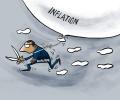
'If all goes well, we may well hit or even surpass the forecast growth rate.'

A host of factors including the reform measures taken by the government and decline in global oil and commodity prices have led to lower inflation, the Finance Ministry said on Wednesday.
GDP growth of 7.7 per cent in the first half of this fiscal has "left sceptics gasping and woefully behind the curve", an RBI article said on Wednesday. It also stressed the buildup in the growth momentum is likely to be sustained. The article on the state of the economy published in the Reserve Bank's December Bulletin on Wednesday also said CPI-based retail inflation is expected to ease to 4.6 per cent in the first three quarters of 2024-25 from 5.6 per cent in November.
The Reserve Bank of India (RBI) on Friday kept key repo rate unchanged at 4 per cent in view of rising inflation and faint signs of economic growth amid gradual lifting of coronavirus (COVID-19) lockdown. The central bank's newly-constituted monetary policy committee (MPC) began its three-day meeting on October 7 and maintained the stance as accommodative. It also kept the reverse repo rate unchanged at 3.35 per cent.

The size of Budget 2024-25 has increased 6.1 per cent to Rs 47.66 lakh crore because of the rise in expenditure and higher allocation for capital expenditure and social sector schemes.

'It is necessary to have a person at the top who can make strict decisions without hesitation. Modiji has done that.'

'Some buyers believe prices may correct in the future.' 'This is unlikely. Many developers are increasing prices amid strong sales and inflationary trends.'

Ahead of the monetary policy review on May 3, Reserve Bank of India (RBI) Deputy Governor Shyamala Gopinath said inflation was a concern, mainly on account of the high prices of non-food manufacturing goods.

With the reality of coalition politics staring the BJP in its face, this was inevitable, points out Ramesh Menon.

The finance ministry is not revising its inflation target of 5 to 5.5 per cent for 2005-06 even after the fuel price hike.

"The main risk stems from the uncertainty surrounding the outcome of the south west monsoon in view of the rising probability of an El Nio event around July-August, and its implications for food inflation," RBI said, as it kept the status quo on key interest rate for the third time in a row.

It's possible to curb tax evasion using high-end technology. But it requires an honest intention to make use of the treasure trove of data that is captured, points out Harsh Roongta.

Chief Economic Advisor V Anantha Nageswaran on Thursday said the economy is expected to grow at 6.5 per cent in the current fiscal notwithstanding deficient rains in August. India recorded economic growth of 7.8 per cent in the April-June quarter of 2023-24 against 13.1 per cent in the year-ago period. India's economy in Q1 grew at the fastest pace in a year, on the shoulders of a boost in capital expenditure both at central and state levels, along with stronger consumption demand, especially in rural areas, and improved performance in the services sector, he said.

RBI targets to keep inflation at 4 per cent, (+/- 2 per cent), and its rise beyond this comfort zone will put pressure on the central bank to hike rates.
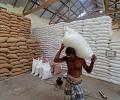
Amid the ongoing festival season and ahead of the elections for five state assemblies, the Centre is closely monitoring inflation, particularly in food items, to enable it to take steps to increase their supplies. "There is a complete no-nonsense attitude when it comes to food inflation, and instructions have been issued at all levels to be very sensitive to any possible price movements in any commodity," a senior official explained. Sources have said that all departments dealing with food items have been instructed to keep a close eye on all commodities and maintain a weekly record of their price movements.
Higher prices of food products and some manufactured items pushed up inflation to 3.21 per cent for the week ended November 17, against 3.01 per cent a week ago.

'The Budget needs to focus more on social welfare schemes.'

Analysts expect inflation to peak in the first half of 2016-17 and moderate, thereafter, on the back of positive impact of monsoons

Probably 35 bps. There could be even an encore in February 2023 to take the policy rate to 6.5% before the financial year ends, predicts Tamal Bandyopadhyay.

Marico's January-March quarter (Q4) results were slightly better than consensus. Revenue was up by 1.7 per cent year-on-year (Y-o-Y) to Rs 2,280 crore. Ebitda grew by 12.5 per cent Y-o-Y to Rs 440 crore. Adjusted PAT was up 10.3 per cent Y-o-Y to Rs 320 crore.

So far, inflation outcomes have closely tracked these projections.
Inflation surged to 5.48 per cent during the week ended December 23, just short of the upper threshold of Reserve Bank's projections for this fiscal, due to rise in prices of some essential manufactured products, food items and minerals.
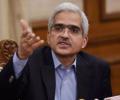
The Reserve Bank of India on Thursday decided to keep policy rate unchanged for third time in a row as it maintains heightened vigil on inflation. The rate increase cycle was paused in April after six consecutive rate hikes aggregating to 250 basis points since May 2022.

India's economic growth will be above 6 per cent in the current fiscal as the country has managed to strengthen its macroeconomic stability and performance even in a period of large global shocks, RBI Monetary Policy Committee (MPC) Member Ashima Goyal said on Monday. Goyal further said that a global slowdown reducing India's export growth, geopolitics fueling oil and food prices, and erratic weather are some of the continuing risks that the country faces. "India has managed to strengthen its macroeconomic stability and performance even in a period of large global shocks.

Since March 2020, WPI food inflation rate continued to fall but the CPI-food inflation rose, signaling a breakdown in supply chain from the mandis to the final household.
The Reserve Bank on Wednesday hiked key benchmark policy rate by 25 basis points to 6.5 per cent, citing sticky core inflation.
The fall in inflation during the week ended March 31 might ease pressure on RBI to tighten monetary policy. But price data to be released next week would play a crucial role in RBI's annual monetary policy review slated for April 24.
RBI in wait and watch mode as several risks to inflation continue to exist including a sudden reversal of food prices and oil price volatility.

According to the global research firm, though a sharp fall in WPI inflation and negative growth in Industrial production is exerting pressure on the RBI to cut rates, the quantum of rate cut will be more important than the timing.
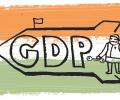
Moody's Ratings on Thursday raised India's GDP growth forecast for FY24 to around 8 per cent from 6.6 per cent on the back of strong domestic consumption and capital expenditure. The estimate comes a day after RBI Governor Shaktikanta Das said the economic growth in the current financial year could be close to 8 per cent in view of the third quarter GDP data released by the government. The latest estimate of Moody's is about 140 basis points higher than the earlier projection of 6.6 per cent made in November 2023.
Inflation has declined to 6.39 per cent for the week ended March 24 as compared to 6.46 per cent in the previous week.

Indian economy is expected to clock an average growth rate of 6.7 per cent till 2026-27 fiscal driven by domestic consumption, S&P Global Ratings senior Economist (Asia Pacific) Vishrut Rana said on Wednesday. He said the economic growth in the current fiscal is expected to come in around 6 per cent, lower than 7.2 per cent clocked in 2022-23. "We are seeing some headwinds from the trade side which is affecting activity and that is one of the factors that is affecting growth this year," Rana said at a webinar.
Inflation declined to 5.95 per cent during the week ended January 13 from a two-year high of 6.12 per cent in the previous week, primarily due to decline in prices of food products.
